

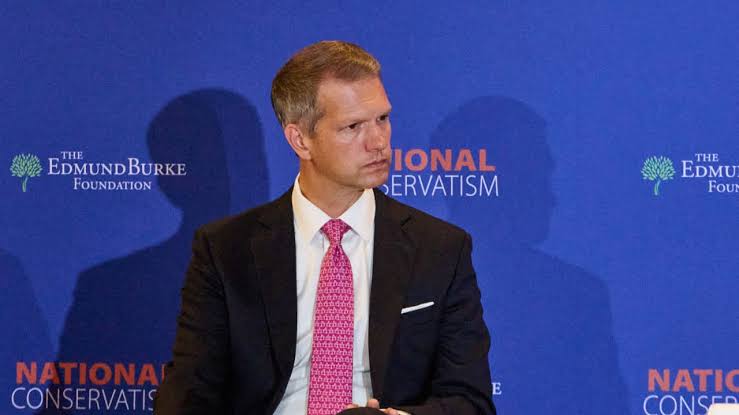
U.S. Representative Riley Moore has welcomed Nigeria’s move towards establishing state police forces. He described the reform as an important step in addressing insecurity and protecting citizens across Africa’s most populous nation. Moore made the remarks following the passage of legislation by Nigeria’s House of Representatives aimed at advancing the creation of state-controlled police forces as part of broader efforts to tackle rising insecurity.
In a statement posted on social media, the U.S. congressman said he had advocated for the policy since being asked by U.S. President Donald Trump to investigate what he described as the persecution of Christians in Nigeria.
Moore said he had raised the issue directly with Nigeria’s First Lady Remi Tinubu during a visit to Washington and discussed it with several Nigerian delegations over time.”Ensuring states can protect their own citizens is a critical step toward ending the persecution of Christians and the overall instability in Nigeria,” Moore said.
He also commended Nigerian President, Bola Tinubu for supporting the legislation and encouraging its passage through the National Assembly.”President Tinubu deserves credit for supporting this legislation and urging its passage through Nigeria’s parliament,” Moore said.
The Lawmaker added that more work needed to be done before state police forces become operational.The Lawmakers on Thursday passed a constitutional bill which allows each of Nigeria’s 36 states to establish and run its own police force alongside the federal Nigeria Police Force. The House of Representatives members overwhelmingly voted for the constitutional bill while it also passed second reading at the Nigerian Senate. The bill was passed after 290 out of the 360 members who attended the plenary voted.
Speaker of the House, Tajudeen Abbas at the end of the voting exercise, revealed how the voting took place “In attendance for the exercise are 290 members, out of which 289 voted in favour of state police. One member voted against, and there’s no nay vote”.
CliqMetro reports that the bill, sponsored by Deputy Speaker of the House Benjamin Kalu and 14 other lawmakers, passed second reading at the on February 20, 2024. The proposed legislation seeks to transfer policing from the Exclusive Legislative List to the Concurrent Legislative List, this will empower states to establish and control their own police formations.
The proposed legislation seeks amendments to Sections 197, 214 and 215, among others, of the 1999 Constitution. The bill, which enjoys cross-party support, must still be approved by at least two-thirds of all state assemblies before taking effect.
Meanwhile the bill was referred by the President of the Senate, Godswill Akpabio, to the Senate Ad-hoc Committee on the Review of the 1999 Constitution for further legislative scrutiny. Policing has been controlled by Nigeria’s federal government, despite regional threats which includes: jihadist insurgency in the northeast, banditry and kidnappings in the northwest and north-central regions, farmer-herder clashes, separatist-linked attacks in the southeast, and oil theft in the Niger Delta.
State governors say they are held accountable for security but lack operational control over police in their states, when this bill becomes law they are expected to be held responsible as they will now be in charge of security in their States.
Nigeria has long debated the creation of state police as a means of strengthening security and improving responses to local threats. Supporters argue that decentralising policing would enhance intelligence gathering and community-based security, while critics have raised concerns about potential political misuse by state governments.
The House of Representatives’ approval marks a significant step in the constitutional amendment process required to establish state police forces.