

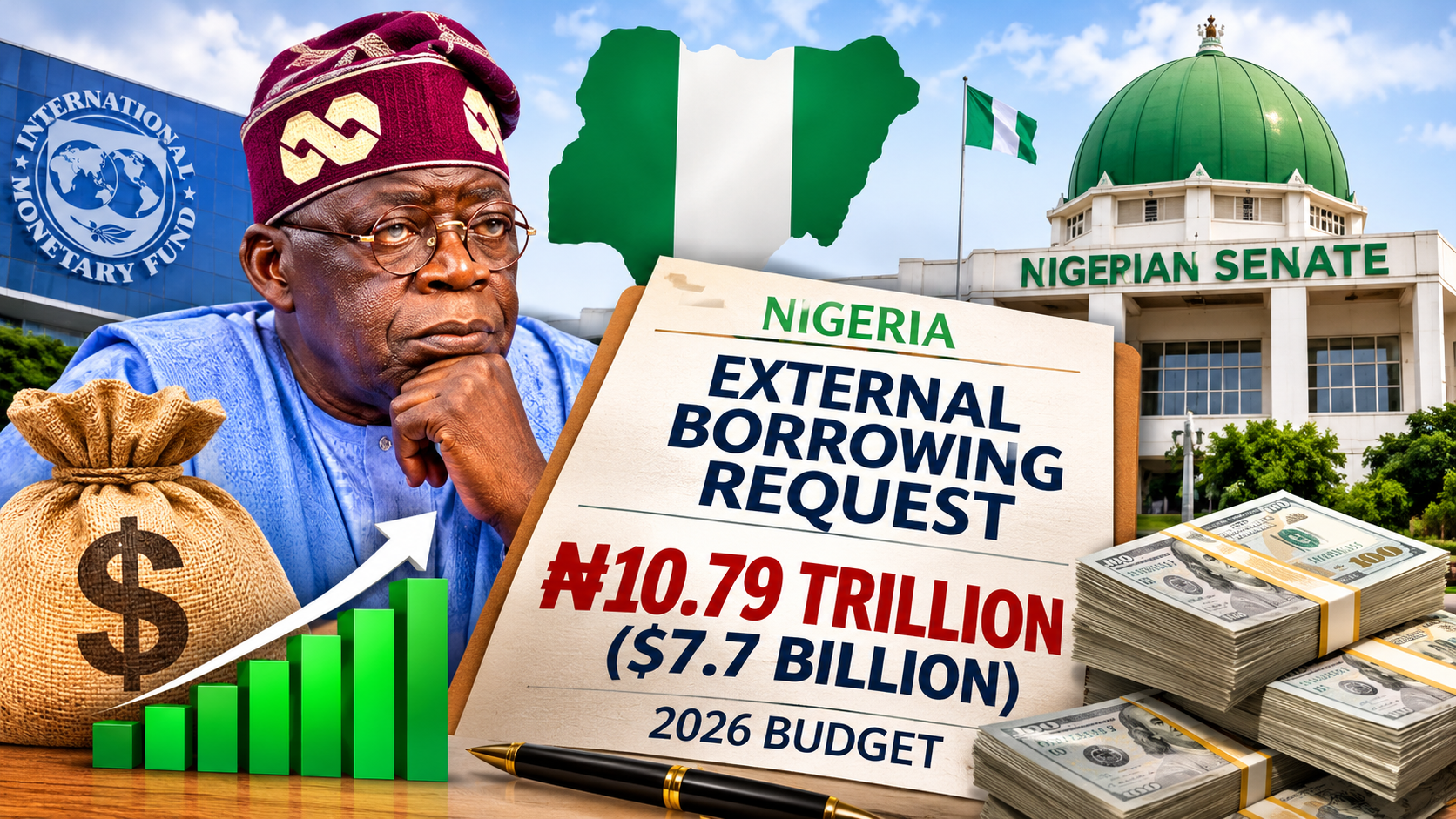
- Bola Tinubu seeks Senate approval for N10.79 trillion in external borrowing.
- The proposed $7.7 billion loan will finance part of the 2026 budget deficit.
- Eurobond issuance is expected to be a major source of funding.
- Senate refers the request to its Committee on Local and Foreign Debt.
The Nigerian Senate has received President Bola Tinubu’s request for approval to secure N10.79 trillion ($7.7 billion) in external loans to finance part of the 2026 budget deficit.
Senate President Godswill Akpabio read the president’s request during plenary, explaining that it was made under Sections 21(1) and 27(1) of the Debt Management Office Establishment Act, 2003.
In the letter, Tinubu recalled that the 2026 Appropriation Act provided for N29.2 trillion in new borrowing to finance a projected budget deficit of approximately N31.4 trillion.
The proposed borrowing comprises N18.4 trillion in domestic loans and N10.79 trillion in external financing.
How Tinubu Plans To Raise The $7.7bn Loan
According to the president, the Federal Government intends to raise the funds through one or a combination of financing options, including concessional and commercial loans from multilateral and bilateral institutions, IMF facilities, bridge financing and Eurobond issuance.
Tinubu said the government would place greater emphasis on Eurobonds because they could be concluded faster and potentially raise substantial funds at competitive costs.
He added that the final interest rates and repayment periods would depend on prevailing market conditions.
The Federal Ministry of Finance and the Debt Management Office would work together to secure favourable borrowing terms.
What The External Loan Will Finance
Tinubu said the proposed funds would support priority projects in defence and security, transportation, agriculture, electricity, education and healthcare.
He also explained that the proceeds would be received by the Central Bank of Nigeria on behalf of the Federal Government and would support the country’s external reserves.
The president asked lawmakers to approve the N10.79 trillion borrowing at the 2026 budget exchange rate of N1,409 to the dollar.
Akpabio Reacts As Senate Refers Request To Committee
Reacting to the correspondence, Akpabio said the latest request superseded an earlier application for $20.3 billion, describing the new letter as more explicit.
He said the government would explore available financing options to obtain favourable terms.
The Senate President subsequently referred the request to the Committee on Local and Foreign Debt, directing it to report back as soon as practicable.
For the accompanying picture, would you prefer a news photograph of President Tinubu and Senate President Akpabio or a designed editorial illustration about Nigeria’s external borrowing?
The Senate has received a request from President Bola Tinubu seeking approval for N10.79 trillion external borrowing equivalent to approximately 7.7 billion US dollars to finance part of the 2026 budget deficit.
Tinubu’s request was contained in a letter seeking the National Assembly for the implementation of external borrowings approved in the 2026 Appropriation Act.
Reading the letter during plenary, Senate President Godswill Akpabio said the request was made pursuant to Sections 21(1) and 27(1) of the Debt Management Office Establishment Act, 2003.
In the letter, Tinubu recalled that the 2026 Appropriation Act provided for N29.2 trillion in new borrowings to finance a budget deficit of about N31.4 trillion.
He explained that the borrowing comprised N18.4 trillion domestic borrowing and N10.79 trillion external borrowing, with the latter forming the subject of the request.
According to the letter, the federal government plans to raise approximately 7.7 billion dollars through one or a combination of available funding sources.
He said the proposed sources included concessional and commercial loans from multilateral and bilateral institutions, the International Monetary Fund, bridge financing facilities, direct borrowing from international financial institutions and Eurobond issuance.
The president said the options would be pursued simultaneously, considering their respective costs, benefits and the time required to access the funds.
Tinubu, however, he said greater emphasis would be placed on Eurobond issuance because it was generally faster to conclude and could raise larger amounts at relatively competitive costs.
Tinubu explained that the final borrowing terms, including interest rates and tenures, would depend on prevailing market conditions at the time of pricing.
He assured that the Federal Ministry of Finance and the Debt Management Office would work to secure the best possible terms for the country.
The president said the proposed borrowing would finance priority projects in defence and security, transportation, agriculture, power, education and health.
He noted that the funds would be received by the Central Bank of Nigeria on behalf of the federal government and would also support external reserves.
The president consequently requested the National Assembly to authorise the federal government to implement the N10.79 trillion external borrowing, equivalent to approximately 7.7 billion dollars, at the budget exchange rate of N1,409 to one dollar.
He also sought approval for the funds to be raised through one or more of the identified sources, with greater emphasis on Eurobond issuance.
Additionally, he requested authorisation for the Minister of Finance and Coordinating Minister of the Economy, working with the Debt Management Office, to take necessary actions to implement the resolution.
Reacting after reading the letter, the Senate President said the latest request superseded an earlier request for 20.3 billion dollars, describing the new correspondence as more explicit.
Akpabio said the government would explore different funding sources to secure the most favourable borrowing terms through a willing-seller, willing-buyer arrangement.
The senate president subsequently referred the request to the Committee on Local and Foreign Debt to report back to the Senate as soon as practicable